Clarity & Control
From costs to clarity.
A structured cost allocation approach helps management understand what drives costs at the level of products and materials.
ClientGlobal organization · more than 4,000 employees
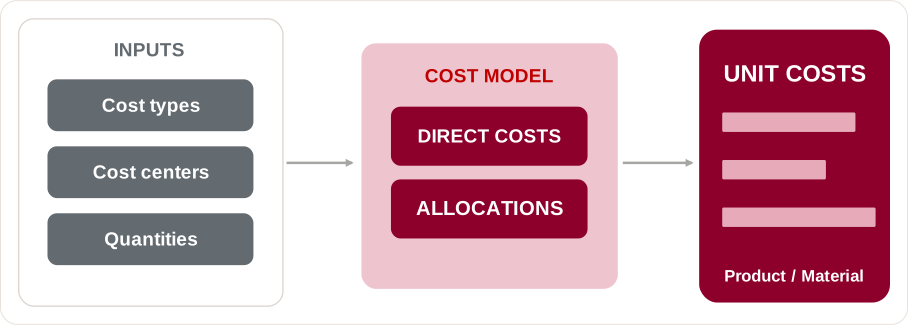 VISUAL MODEL / SCHEMATIC
Understand the situation.
Existing cost reporting by cost type and cost center was insufficient for internal steering and customer discussions.
Design a response.
Create an inventory of quantities for relevant products and materials.
Build a basis for action.
A more decision-ready view of unit costs.
Build cost clarity layer by layer.
Existing cost reporting by cost type and cost center was insufficient for internal steering and customer discussions. Material and product costs required greater detail and validation.
The steps summarize the engagement described in SOICON's existing Results materials. They are not performance measurements.
01
Build the quantity base
Create an inventory of quantities for relevant products and materials.
02
Identify direct costs
Trace cost components that can be directly assigned.
03
Allocate indirect costs
Define rules and distribution keys for costs that cannot be assigned directly.
04
Validate the model
Review completeness and acceptance of cost data with middle management.
A more decision-ready view of unit costs.
A structured representation of material and product unit costs, based on quantity information, direct-cost assessment and agreed allocation logic.